Incident Reports in Greenville, SC can be accessed instantly through the city’s online portal, where a simple incident report search by number, date, or location returns the exact record you need. Whether you’re looking for a police incident report on a traffic collision, a theft incident report, or public incident reports for a neighborhood safety review, the searchable incident report database pulls official incident records from the law‑enforcement agency in seconds, helping residents and businesses stay informed without waiting for a request form.
When you need to find an incident report online, start by entering the case ID or incident date into the incident report lookup tool on the Greenville Police website. The system supports incident report search by address, name, or even report number, and instantly shows whether the file is public, redacted, or still under investigation. This quick incident report search by location not only saves time but also clarifies if a certified copy can be requested, ensuring you get the right information when you need it.
How to Search Incident Reports
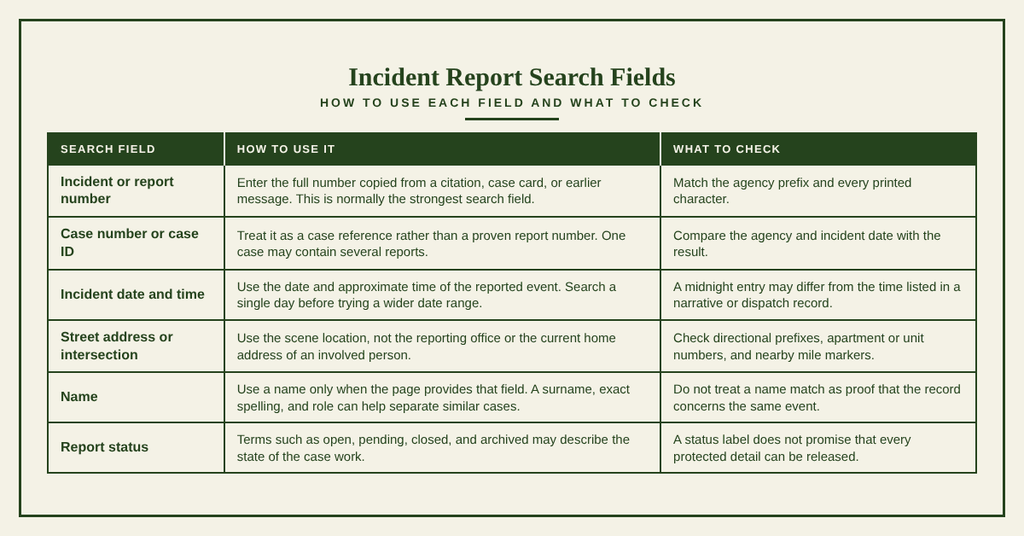
Incident Reports in Greenville County start with the agency that created the record. Use the official GCSO site to locate its lookup or records-request page, then use the most exact field you have. You can also visit greenville county sc for broader county resources. A report number, case ID, incident date, and scene location narrow a search better than relying on an incident type alone. Confirming the reporting agency keeps the request with the office that holds the file.
Official Search Portal: https://gcso.org/
Steps to Search
- Open https://gcso.org/ and use the main menu or site search for terms such as “Records,” “Report Copy,” or “Public Records.” Menu labels can change, so a service term may work better than one exact page name.
- Choose the path for the record you need. A public index may help locate a case, while a request form may be used to order a full copy. If the site offers both, use the index for a quick check and the request form for document delivery.
- Confirm the reporting agency before submitting anything. A report made by the Greenville Police Department, South Carolina Highway Patrol, or another agency may need to come from that agency. A call receipt, case card, citation, or message from an officer can help identify the correct office.
- Gather every known identifier, including the report number, case ID, incident date, incident time, scene address, nearest intersection, and report type. Separate the incident date from the report date, since the two may fall on different calendar days.
- Use the report or case number without changing any characters. Do not remove a letter prefix, leading zero, or hyphen unless the page gives that instruction. If no number is available, combine the date with the most precise location and search one day at a time.
- Compare each result with the agency, incident date, scene, and incident type. A call-for-service entry, original report, and later supplemental report may appear near the same case. Confirm that the result is the full report before treating it as the requested file.
- Complete the official request page with the reporting agency, identifiers, record type, contact method, and delivery choice. If you need the narrative, supplements, property sheet, collision diagram, or arrest-related page, name each item instead of ordering a vague “case file.”
- Save the confirmation number, receipt, and every identifier used in the request. If no result appears, contact the records office listed at the end of this page and ask for a targeted search. A written request can also create a record of what was sought and when it was sent.
Categories of Incident Reports
Agencies may file the same event under several labels, such as incident, complaint, case, report, or supplemental report. The title often reflects the event reported at dispatch, while the narrative and case status show what officers later recorded. Each part may have its own number, date, or release status, so request the exact record parts needed rather than relying on a broad category name.
Theft, Burglary & Property Damage
A theft, burglary, or property-damage report may list the scene, reported items, serial numbers, vehicle details, damaged areas, and the status of the case. A later report can add recovered property, witness statements, photographs, or a change in the case status. Search by incident date and address, then use the property description to confirm that the result matches the reported loss.
The report title may not capture every fact. A case labeled as burglary can contain questions about entry, intent, or the type of property taken. A case labeled as theft can include damage discovered after an item was stolen. Read the report type and narrative together, and ask for supplements if a later event changed what officers found or learned.
What to request for a theft or property-damage record
Ask for the original incident report, later supplemental reports, property or evidence sheets, and a case-status page when those records exist. Provide item descriptions, vehicle identifiers, and the exact loss location if they are known. These details can help the records office distinguish your incident from other losses reported on the same street during the same period.
Traffic Collisions & Vehicle Incidents
A traffic collision may produce a crash report, a written narrative, a supplemental report, a citation, or several related pages. The reporting agency can depend on the road and event. A collision on a state highway may involve the South Carolina Highway Patrol, a county road may involve GCSO, and a city street may involve the Greenville Police Department. One office may not hold a report created by another.
A police collision report and a South Carolina Department of Motor Vehicles form serve different purposes and may come from separate agencies. State which document you need. If you need the police version, request the crash narrative, diagram, vehicle and property details, cited driver information, and any supplemental pages that are available for release.
Vehicle searches work best when the date, direction of travel, and scene location are added to the report number. If a search by street address fails, try the nearest intersection or road junction and confirm whether the report lists a mile marker. That small change can reveal a report stored under a slightly different location description.
Assault, Fraud & Financial Crimes
Reports involving assault, threats, fraud, or financial loss often receive careful review before release. The filed report may describe the call, statements, injuries, alleged property transfers, or investigative steps without deciding the truth of every claim. An active case can also have restricted witness, victim, medical, or financial details. A search result may therefore show less than the complete report held by the agency.
Bank records, merchant receipts, account statements, and other financial papers are usually separate from a police report. The police file may state that a loss was reported without containing the underlying account records. For a complete review, request the police report and list the outside records needed for the separate issue.
Incident report and arrest record are different files
An incident report documents a call, event, or investigation. An arrest record may include separate booking, custody, charge, and court records. One report can mention an arrest without serving as the full arrest or conviction history. Ask the agency which document contains the facts you need, and request court disposition records from the proper court office when a case has reached court.
Missing Persons & General Service Calls
A missing-person report may be updated when new facts arrive, so the date shown in an old search result may not reflect the latest case status. Searches by report number, date, and the location last seen remain useful. Active details about a missing person may be limited for safety, and a later bulletin may be a separate record from the original report.
General calls can include suspicious activity, welfare checks, civil disputes, trespass complaints, and other service calls. A call-for-service entry may not have a full incident report or may use a computer-aided dispatch, or CAD, number. Ask whether the call log and any related incident report are separate records. This step helps explain why a call appears in one system but cannot be found under another case number.
Obtaining Official Incident Reports & Files
South Carolina’s Public Records Act allows people to request records held by public bodies, subject to legal exceptions. Under S.C. Code Ann. § 30-4-50, a request may be made in person or in writing, no special form is required, and the request must describe the records with enough detail for the agency to locate them. An agency form remains useful because it can collect payment, delivery, certification, and contact choices in one place.
Online, In-Person & Mail Request Procedures
Use one clear request for each incident. Include the reporting agency, report or case number, incident date, incident time, scene location, incident type, and the exact record parts needed. If no number is available, add the nearest intersection, ZIP code, involved-party names, and a short event description. A dated dispatch message or case card can supply details that a memory-based request may miss.
Online request
Start from the records or report-request page on the official GCSO website. Complete each field shown on the form, select the needed record type, and provide a delivery choice. You can also consult divorce decree to locate official filings. If the form asks for a reason for the request, describe the record sought in plain terms rather than adding personal details that are not required. Save the submitted form, confirmation number, and receipt before leaving the page.
In-person request
Call the office before a visit to confirm the accepted request method and which records can be provided at that counter. Bring the identifiers, payment method, and a current contact address. A government-issued photo ID may be needed for identity checks. If you act for another person, bring written authority or the document that shows your role, such as a court appointment or power of attorney.
Written request by mail
Mail the request to the address at the end of this page. Include a signed letter or the official form, all known identifiers, a daytime contact method, and the requested delivery method. Ask whether the office needs a stamped return envelope or a separate payment. Keep a complete copy of everything mailed and record the date it entered the mail.
Certified Copies, Processing Timelines & Copy Fees
A regular copy presents the record as produced. A certified copy adds an official statement that the agency attests to its authenticity. Ask whether GCSO offers certification for the requested incident report and whether the certificate requires a signature, seal, or separate fee. Courts, insurers, employers, and other receiving offices may set their own certification rules, so check those requirements before paying.
Current copy charges depend on the record, page count, images, attachments, delivery method, and certification request. Older fee claims may describe another agency or a different type of record. Ask the records office for the current fee schedule and a total estimate before ordering. This step can prevent a surprise charge when a file contains many scanned pages or separate report parts.
S.C. Code Ann. § 30-4-60 generally provides a ten-business-day response period for a public-records request. That rule concerns the agency’s response; it does not promise that every page will be copied, reviewed, and delivered within ten business days. A response may confirm receipt, request missing details, state a reason for more time, or provide a production date.
Current cost and timing checklist
- Ask when the records office expects to complete its search.
- Ask whether the incident report is in active, closed, or archived status.
- Ask whether supplemental reports or later case-status pages exist.
- Ask for the current copy fee, delivery fee, and certification fee separately.
- Ask whether payment is due before the search, before copying, or before delivery.
- Ask for a reference number and the best way to check the request’s progress.
Public Availability, Redactions & Privacy
Availability depends on both the record’s legal status and the details inside it. A report can be a government record while remaining closed during an investigation, or it can be released with protected fields removed. A search result, status label, or file title offers only a quick clue. The agency’s release decision controls what can be provided.
Public Record Transparency vs. Active Investigation Holds
Many incident reports become public records, but that fact has two limits. Records compiled for a criminal investigation may remain unavailable until the investigation ends and the case reaches its final disposition. A released report may still omit details protected by another law. S.C. Code Ann. § 30-4-90 addresses the need to withhold investigative records during that period and provides for disclosure after the investigation and case disposition, subject to other legal limits.
A label such as open, pending, active, inactive, or closed describes case work rather than the full public-release decision. A closed case can still contain protected victim, witness, juvenile, medical, or investigative details. A pending case may have a basic event summary without a full narrative. Ask the records office for the status of the exact report and the legal basis for any withheld material.
A records request does not guarantee immediate delivery or every version of a file. If the office denies a request, ask for a written response that identifies the record denied and the stated reason. A requester can then determine whether the response needs correction, a narrower request, or further review under South Carolina law.
Protected Victim, Witness & Juvenile Information
Victim and witness safeguards may cover names, addresses, phone numbers, locations linked to safety plans, medical details, and other fields that could create harm or defeat an investigation. A report may show that a person was interviewed without publishing the person’s identity. The agency can sometimes provide a redacted version that preserves the event narrative while removing protected identifiers.
Juvenile records have separate legal treatment. S.C. Code Ann. § 16-17-430 protects juvenile records from public disclosure, subject to the exceptions stated in state law. A report that mentions a juvenile does not always have the same release status as every related juvenile document. Ask the records office to apply the rule that fits the specific record rather than grouping all juvenile-related files together.
An involved party does not automatically receive every withheld detail. State your role, such as victim, witness, family member, attorney, or authorized representative, and provide legal authority when it applies. The records office can then decide which disclosures are permitted. A request based on personal involvement may support a different review process, yet it does not cancel every privacy or confidentiality rule.
Redacted Details & Confidential Record Rules
A redacted copy remains an official copy. A black box, blank, or exemption marker shows that material was withheld under a stated legal or policy basis. It does not mean that the missing fact never existed, that no one reported it, or that the event had a different outcome. Compare a redacted narrative with the incident date, location, and visible identifiers before drawing a conclusion.
Depending on the file, protected fields may include a juvenile’s identity, a witness’s contact details, medical facts, personal phone numbers, confidential sources, or material connected to an active case. The exact list depends on the record and the law that applies. Do not assume a field is open merely because another copy of the report shows it.
Ask whether a narrower record can be produced with fewer protected fields, such as an incident summary without witness details or a narrative without personal identifiers. If the office withholds whole pages or sections, ask for the reason and the legal basis. A written explanation lets the requester decide whether to seek a different form of the record or ask for agency review.
Record Accuracy & Resolution
Finding a file and trusting every field are separate tasks. A report may contain an early description, a later supplement, or a factual error that has not been corrected. You can also explore divorce records through available county records. Keep the report number, source documents, and case status together so that later calls can refer to the same file. A clear record of what was requested also helps the office trace a problem without starting over.
Processing Delays for Recently Filed Reports
A recent incident report may not appear at once because the officer still has to complete the narrative, the report may be waiting for review, or a later event may require a supplemental report. A case can also remain under active review after the first public search result appears. The report date may fall later than the incident date because staff created or updated the file after the event.
Do not assume that every field exists from the first day. An early result may lack the final disposition, a corrected address, or the narrative of a later response by officers. Ask whether the report is still being written, whether a supplemental report is pending, and when the file is expected to reach a stable status.
For a court, insurance, employment, or deadline-driven request, obtain a written status and estimated completion date as early as possible. A request receipt does not set a completion date unless the office provides one. If a deadline falls before the estimated production date, ask which party must follow up and how the agency can document the delay.
Resolving Incorrect Case Numbers or Address Mismatches
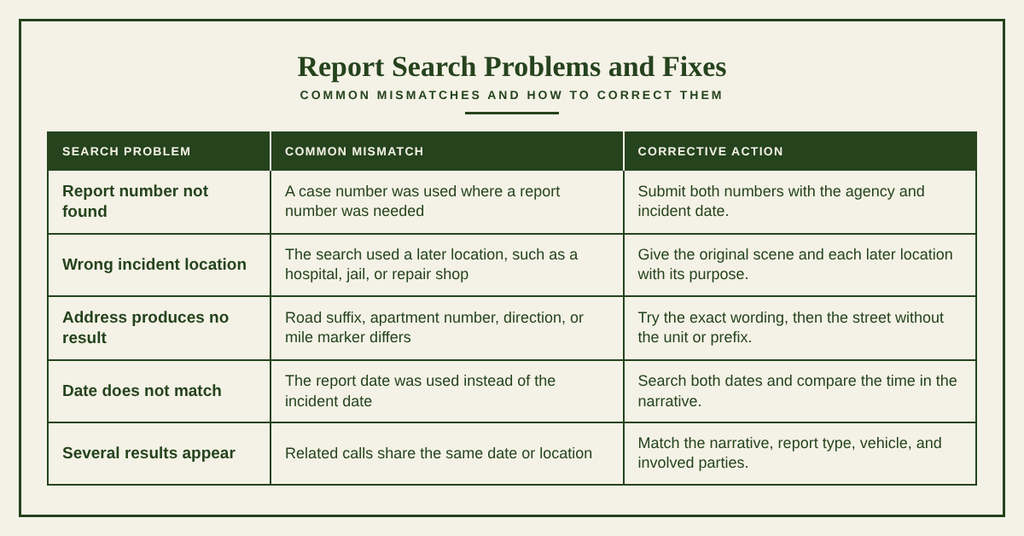
Case numbers and report numbers can refer to different parts of the same matter. A citation may show one number, a court file may show another, and a records system may list both with a prefix. Give the records office every number found and state which one came from which document. Never guess by dropping the first few digits or replacing one identifier with another.
Address searches can fail when a report lists the nearest landmark, highway mile marker, apartment entrance, hospital, or a later location connected with the event. Start with the scene shown in the source document. If that search fails, try the street name without an apartment or directional prefix, then use the nearest intersection. A location written differently in the report may still represent the same place.
Requesting a factual correction
Separate a factual error from a disagreement about how events happened. A receipt, photograph, medical record, repair estimate, dispatch time, or witness statement can support a correction request. Send a short written account of the disputed field, attach or cite the supporting records, and ask for a factual review.
The agency may add a correction or supplemental report while preserving the original document. Ask how the agency records disputed facts and whether the corrected material appears as a new page. A correction request does not by itself change a court case, an insurance decision, or an earlier official record.
What to Do If an Incident Report Cannot Be Found
A missing search result does not prove that no report exists. The file may sit under another agency, use a different identifier, remain outside the public index, or await a later release decision. Work through the problem in steps so each action tests a different cause.
- Confirm the agency that responded and the date of the call. If a state highway or another jurisdiction was involved, contact that agency instead.
- Repeat the search with the report number and case ID placed in separate fields. Add the incident date or scene address only after checking the number by itself.
- Try one changed field at a time. Remove an apartment suffix, use a nearby intersection, test the report date beside the incident date, or check whether a leading character was missed.
- Ask the records office to search by the available details. Supply a short timeline, vehicle description, property involved, and the names of any known officers or witnesses.
- Ask for the report’s status and related identifiers. The office may know of a supplemental report, case number, archived location, or incident review that does not appear in the public index.
- Request a call-for-service or CAD record if no incident report was filed. These records can show that a call occurred even when no full report number was assigned.
- Send a written request if the first contact produces no result. Ask for a “no record located” statement, a search estimate, or the reason a located record cannot be released.
Keep copies of every request, receipt, search result, and staff response. If the file is withheld, ask whether a redacted version or a narrower report part can be produced. If the response is incorrect or incomplete, preserve the original wording and request a written correction rather than relying on an unrecorded conversation.
Contact Information
Contact the office with the reporting agency, incident number, case ID, date, time, scene location, and record type ready. If you act for another person, state your role and legal authority. Ask for the current request method, copy fee, processing estimate, delivery choices, and certification options before placing a paid order.
Frequently Asked Questions
Find quick answers on locating, requesting, and understanding incident reports for Greenville, SC.
How to search an incident report online
Visit the Greenville County Sheriff’s Office portal at https://gcso.org/. Choose the “Incident Report Lookup” link. Enter the most precise detail you have—report number, case ID, date, or address. The site filters results and displays matching records. If the report is public, you can view a summary and request a full copy. For help, call (864) 271-5210 during office hours.
How to find an incident report by number
Start at the GCSO online search page. Locate the field labeled “Report Number” or “Case Number.” Type the exact number and submit. The system returns the specific incident if it is available to the public. If the number is incorrect or the record is restricted, the portal will indicate the issue. You can verify the number with the agency by calling the office.
How to request a copy of a police incident report
Complete the “Incident Report Request” form on the GCSO website or call the records division at (864) 271-5210. Provide the report number, incident date, and requester’s contact information. Pay any applicable fee; the office confirms the amount when you call. Requests are processed during regular business hours, Monday through Friday, and you receive the copy by mail or email within the stated time frame.
Are incident reports in Greenville public records
Most incident reports filed by the Greenville County Sheriff’s Office are public unless they involve juveniles, ongoing investigations, or contain protected personal information. Public records can be accessed through the online lookup tool or by submitting a records request. If a report is sealed or redacted, the portal will note the restriction and you may need to contact the agency for clarification.
Why an incident report may not show in search
A report might be missing from the online database if it is still under investigation, has been archived, or contains confidential details. Errors in the entered date, location, or report number also prevent matches. In such cases, call the records office at (864) 271-5210 for assistance. Staff can confirm the report’s status and advise on any additional steps required to obtain it.